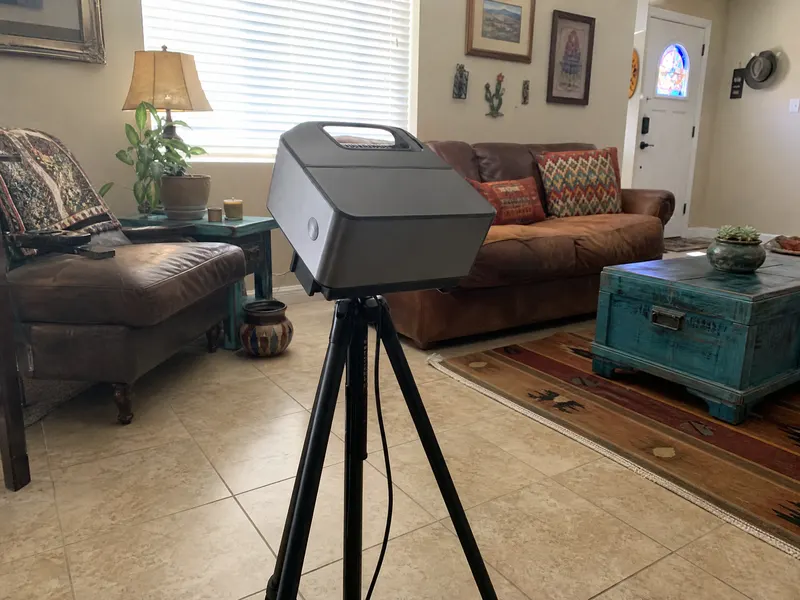
How Our 48-Hour Professional Test Works
A calibrated continuous radon monitor goes on a tripod in the lowest lived-in level of the home, away from drafts, exterior doors and the AC supply. The house stays in closed-house conditions, normal living but windows shut, for the duration. Forty-eight hours later the monitor comes down and prints an hour-by-hour record: average concentration, overnight peaks, humidity and temperature, and any pressure or movement events that suggest someone cracked a window or moved the device.
That hourly trace is the difference between a professional test and a charcoal packet. Radon levels in a house can swing 3x between 2pm and 4am. A single smeared average can't tell you whether your 3.8 is really a steady 3.8 or a house that spends every night at 7. The trace can.
When to Test, Phoenix Edition
The standard advice says test in winter when the house is closed up. Fair enough, November through February is prime testing season here too. But Phoenix has a second closed-house season nobody writes about: summer, when the house is sealed tight around the AC for four months straight. We test year-round and the summer numbers are every bit as real. The only conditions we'll reschedule around are monsoon storms, because the pressure swings of a big storm front can distort a 48-hour window.
What You Get
Same-day report when the monitor comes down. The measured average, the hourly graph, and a plain-English paragraph saying one of three things: you're fine and here's when to retest; you're in the 2.0 to 4.0 gray zone and here's the honest tradeoff; or you're over 4.0 and here's a fixed mitigation price, with the $165 test fee credited against the job. Under 2.0 and considering us anyway for peace of mind? We'll tell you to keep your money. In writing, if you like.
Also worth knowing: the Arizona radon levels page has the statewide data, hot-spot map and county numbers if you want to see how your area trends before spending anything. Mid-purchase? The real estate radon service is built around inspection deadlines. Well water in Cave Creek or Rio Verde? Mention it, radon rides in on well water too and we test for that separately.
Common Questions
How long does a radon test take?
48 hours for a professional continuous monitor test, which is the minimum the EPA protocol allows for a decision-quality result. Long-term tests of 90+ days exist and are actually more representative, but almost nobody in a real estate window has that kind of time.
Are home radon test kits accurate?
Reasonably, if you follow the closed-house instructions and mail them promptly, and they're a fine cheap first look. What they can't do is timestamp the data hour by hour, flag a window that got opened on day two, or hold up in a real estate negotiation.
What is a safe radon level?
There's no true zero-risk level; the EPA action level is 4.0 pCi/L, and the EPA suggests considering mitigation between 2.0 and 4.0. Outdoor background air is around 0.4. Our mitigated homes typically land under 1.0.
Book your radon test today: (520) 423-5900.