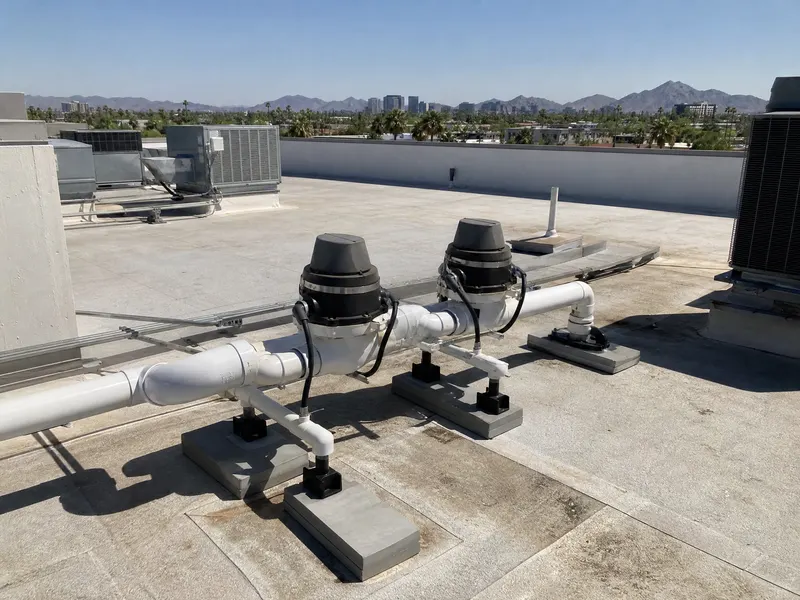
Big Slabs Are a Different Sport
A 40,000 square foot slab is not eight houses; it's one pressure field problem with grade beams, vapor barriers, elevator pits and utility corridors carving it into zones. Design starts with communication testing: small test holes across the slab, a vacuum applied at candidate suction points, and micromanometer readings mapping how far each point's influence reaches. From that map comes the real design, suction point count, manifold routing through mechanical chases or across the roof, fan bank sizing, and electrical load. Guessing at this stage is how buildings end up with eleven fans doing the work of four, or four doing the work of eleven.
Buildings We Handle
Office and medical condos. Schools and daycares, where testing is increasingly required and where working around occupancy hours matters. Multifamily, garden-style to mid-rise, including phased installs that don't require vacating units. Warehouses and flex space with tenant-improvement triggers. And commercial properties over or near VOC plumes, where the job is vapor intrusion rather than radon; that work is covered in depth on the vapor mitigation page and often runs under ADEQ or EPA oversight with lab-verified closure sampling.
What You Get
A written scope with drawings, a fixed price, installation scheduled around your occupants (nights and weekends cost less than you'd fear), post-mitigation verification testing across the footprint, and documentation packaged for whoever needs it: the lender's consultant, the district facilities office, or the agency file. Systems get labeled, monitored, and handed over with an O&M sheet a building engineer can actually follow. Maintenance contracts with annual retesting are available and cheap, because a dead fan discovered at the five-year retest is a bad way to spend goodwill.
Fixed bid from your Phase II or test data, usually within the week: (520) 423-5900.