The Phoenix Part: Post-Tension Slabs, Attic Heat, and Caliche
Most mitigation guides are written for Midwest basements. The Valley is a different animal, and it changes the install in three ways.
Post-tension cables. If your home was built after the early 90s, odds are the slab is laced with steel cables under thousands of pounds of tension. Cut one and you're looking at a five-figure structural repair and a genuinely dangerous afternoon. Before any core drill touches concrete, the slab gets scanned and the cable paths marked out. The scanner lives in the van. This step is why we will never quote a "we'll just drill in the corner" install over the phone without asking what year your house was built.
Attic routing and heat. Phoenix attics hit 140 degrees or more in summer, which cooks cheap fans. We mount fans where the manufacturer's temperature spec allows, use UV-rated pipe and paint on any exposed exterior run, and schedule summer attic work for early morning starts. If a crew shows up at 1pm in July planning to spend three hours in your attic, they are going to rush the job. Ours start at 5am in the hot months and are out of the attic by ten.
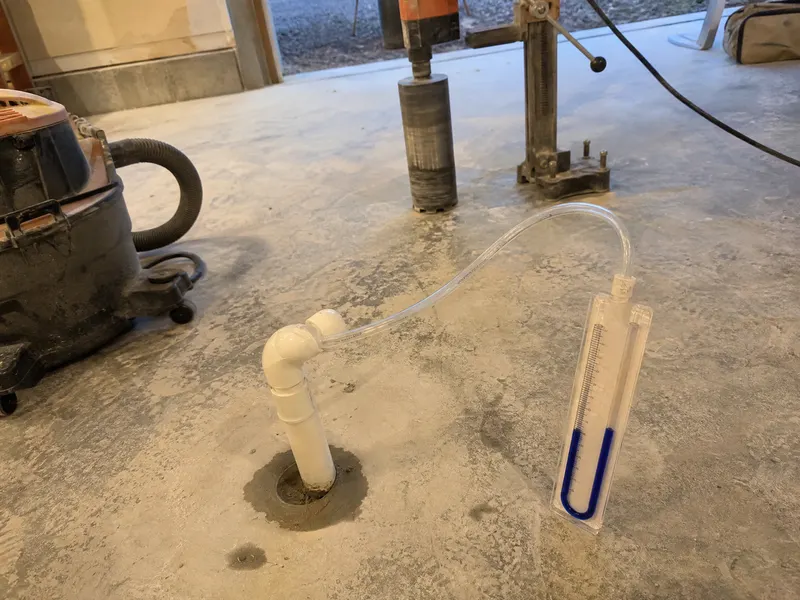
Soil and caliche. A lot of Valley lots sit on caliche, a cemented hardpan layer that changes how air moves under the slab. Sometimes it helps by channeling suction further; sometimes it seals off half the slab from a single suction point. Our diagnostic includes drilling a couple of small test holes and measuring pressure field extension with a micromanometer, so we know one suction point will cover the house before we promise it will. When it won't, we quote the second point up front rather than surprising you mid-job.
What's Included in Every Install
Slab scan and pressure field diagnostics. Suction point and sealed pit. Pipe run, fan, and electrical hookup by a licensed electrician where new circuits are needed. Sealing of accessible slab cracks, plumbing penetrations and the sump or expansion joints that act as radon highways. A U-tube manometer on the pipe so you can see the system working at a glance. Labeling per AARST standards, a five-year system warranty, and a post-mitigation test with a written result under 4.0 pCi/L, guaranteed.
One thing we keep fixing: discharge pipes that dead-end under an eave or next to a bedroom window, quietly feeding exhaust back into the house. We've re-piped a dozen of these from other installers in the last two years. Discharge goes above the roofline, away from openings, full stop. It's in the standard for a reason.
Curious what all this costs? The honest answer is a range, and the cost guide breaks it down line by line. Most Phoenix homes land between $1,400 and $2,600. Testing first? Start with a 48-hour professional test, and if you're mid-transaction see the real estate service.
Common Questions
How long does a radon mitigation install take?
One day. A typical Phoenix slab-on-grade install runs four to six hours. Complex layouts with a second suction point or a long attic run can stretch to eight.
Why is my house high when my neighbor's is low?
Radon follows the cracks, literally. Two identical floor plans can sit over different soil pockets, different fill compaction, and different slab crack patterns. One reads 1.8 pCi/L and the house next door reads 9. It's also why a neighbor's low test is not information about your house.
What warranty do you offer on radon mitigation systems?
Five years on the complete system, on top of the fan manufacturer's warranty, and a written guarantee that your post-mitigation test comes in under 4.0 pCi/L or we modify the system free until it does.
Will the system be visible from the street?
Usually not. Most of our Phoenix installs route through the attic with a discharge above the roofline, which HOAs prefer and which also keeps the pipe out of the summer sun. Exterior runs, where needed, get painted to match the stucco.
Do you need radon mitigation in Phoenix? Call (520) 423-5900 or send the form. Fixed prices, guaranteed results.